
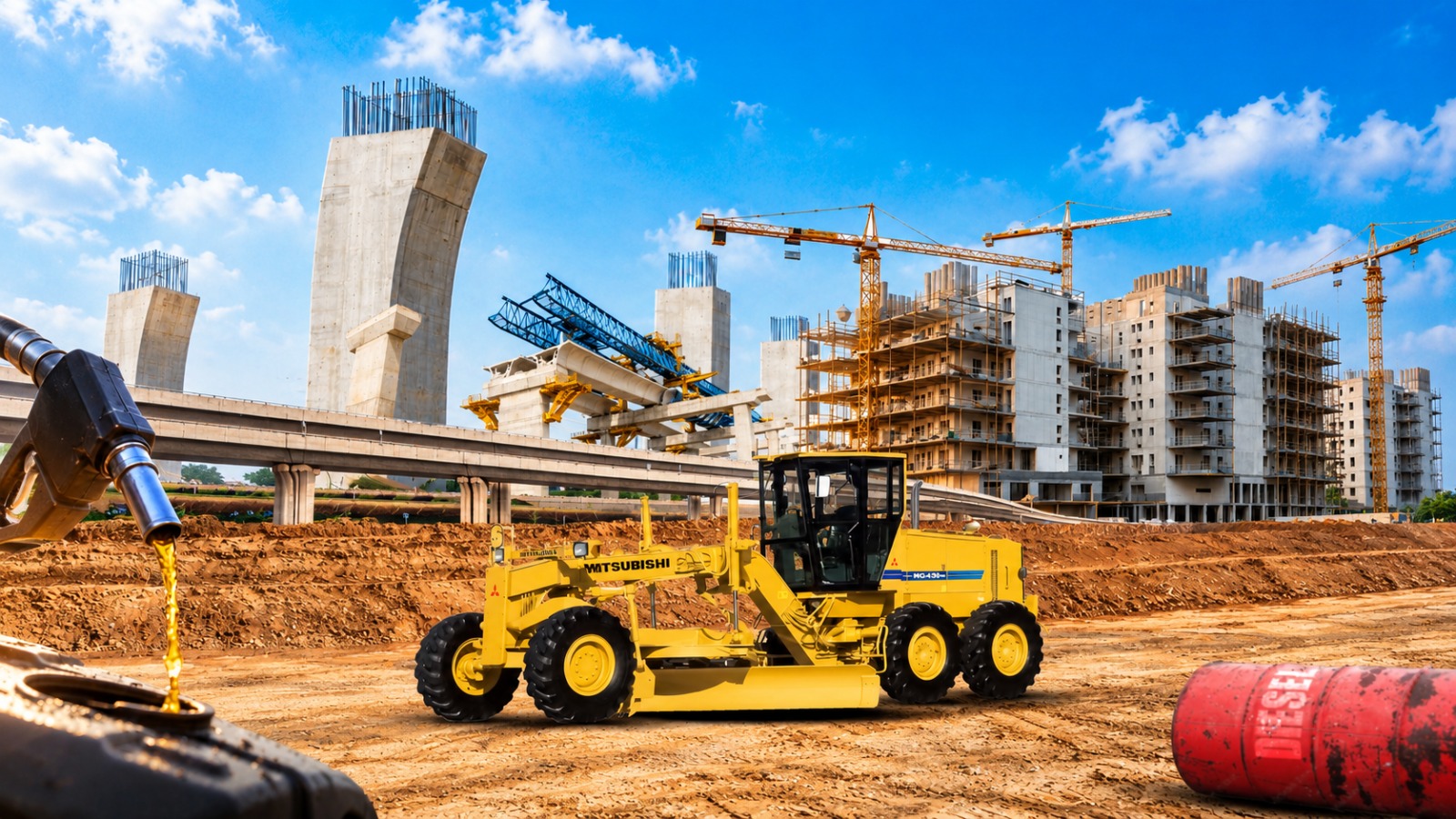
Hypothetical example: This article is designed to help readers in Jabodetabek practically measure excavator fuel (diesel) consumption and estimate costs responsibly, without claiming any specific consumption figure for any machine model. All calculations below are for educational illustration only—you are encouraged to keep your own records in the field.
Why Record Excavator Fuel Consumption?
- Diesel fuel cost is a major component of excavator operating expenses.
- Tracking consumption helps owners and operators recognize usage patterns, differentiate productive hours from idle time, and identify opportunities for efficiency or maintenance needs.
Recording fuel fills and machine hours is encouraged by large manufacturers such as Caterpillar to support cost management and maintenance. However, there is no single universal industry standard for how to keep these records. Always use real data from your own equipment. [CAT-FUEL]
Basic Steps to Measure Excavator Fuel Consumption
- Fill up the fuel tank before starting work.
- Record the starting hour meter position.
- Operate the excavator as needed for the job.
- After the shift is done (for example, after 8 h), refill the tank to full and note the amount of fuel refilled (for example, 80 L).
- Record the ending hour meter position. Calculate total work hours (for example, the difference is 8 h).
Fuel Consumption Calculation Formula
The formula for average hourly fuel consumption:
Fuel consumption per hour (L/h) = Total fuel used (L) / Total work hours (h)
Hypothetical arithmetic example:
- In one work shift, fuel used = 80 L
- Total working hours = 8 h
- Thus: 80 L / 8 h = 10 L/h
Note: These numbers are illustrative only. They are not a reference for any model, type, or working condition. [CALC-01]
Calculating Estimated Fuel Cost
If you know the fuel price per liter (for example: 12500 IDR/L), you may estimate:
- Total shift cost (for 80 L): 80 x 12500 = 1000000 IDR
- Cost per hour: 1000000 IDR / 8 h = 125000 IDR/h
This approach is useful when preparing a Bill of Quantities (BoQ) or estimating operational expenses. Note, all volume and price values above are purely for illustration. Actual diesel prices and working consumption rates will vary depending on the excavator’s condition, work type, idle time, and fuel grade.
Factors Affecting Excavator Fuel Consumption
- Machine maintenance and mechanical condition
- Operator habits (long idle time increases fuel used without productivity)
- Type of job (e.g., heavy-duty digging vs. light work)
- Quality and specifications of fuel
Practical Recording Tips
- Maintain a logbook (manual or digital) to write the date, starting hour, ending hour, fuel quantity, and job details.
- Repeat measurement consistently to analyze weekly or monthly trends.
Numbers such as 80 L, 8 h, 10 L/h, 12500 IDR/L, 1000000 IDR, and 125000 IDR/h may appear in illustrations, but should not be assumed as a benchmark for every excavator. Always compare against your own unit’s real-world records.
Limits and What This Article Cannot Tell You
- This article does not provide recorded consumption for any model of excavator.
- No claims of efficiency, savings, rental rates, or operational guarantees are made.
- The calculations shown cannot be used to compare across brands or production years.
Conclusion
Jabodetabek readers can start tracking excavator fuel consumption using this simple approach. Real data from your equipment will help with budgeting, estimating fuel needs, and keeping your machines running optimally.
This arithmetic is for educational guidance only and does not replace field measurements or official manufacturer documentation.
References
- CAT-FUEL — Caterpillar: Fuel Efficiency New
- CALC-01 — Contoh aritmetika hipotetis, bukan data operasi JML
Plan your next step
Explore the equipment catalogue, then prepare the location, schedule and task details for your enquiry.
Explore rental equipment ↗